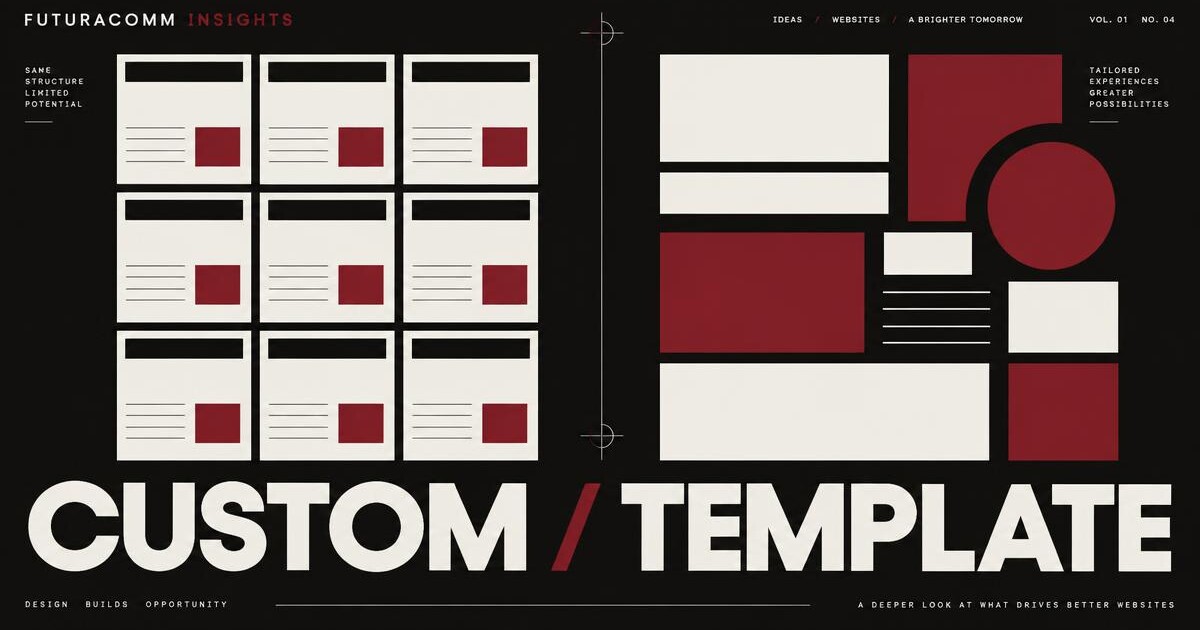
Most custom-website comparisons begin with price.
A template is often described as cheaper and faster. A custom website is described as more expensive and slower. Then, usually, the company writing the comparison declares that the option it sells is the obvious winner.
That is not a useful way to make the decision.
A template can be exactly right for a young business with one offer, a small amount of content, standard functionality, and an urgent need to establish a credible presence. A custom website can be a poor investment if it is beautiful but confusing, slow, difficult to maintain, or disconnected from the way customers actually buy.
The real question is not whether one approach is universally better.
It is this:
Does your business fit comfortably inside a predesigned structure, or does the website need to be shaped around how your company is positioned, discovered, evaluated, and hired?
That is the point where custom work begins to earn its cost.
The short answer
Choose a template when the website’s job is simple, the buying path is familiar, the content fits a standard structure, and speed or budget matters more than differentiation.
Choose a custom approach when the website must translate a mature reputation, explain a nuanced offer, serve multiple audiences, support organic or paid acquisition, qualify leads, connect to business systems, or create a distinctive level of trust.
For many established businesses, the most important difference is not the origin of the code. It is the origin of the decisions.
In a template-led project, the business is adapted to the layout.
In a genuinely custom project, the layout, message, page architecture, and inquiry path are adapted to the business.
What “template” and “custom” actually mean
A website template is a predesigned framework. It may include page layouts, navigation patterns, reusable sections, type styles, and standard features. Modern templates can be attractive, responsive, accessible, and technically sound when they are selected and implemented well.
A custom website should begin with the company’s actual requirements: its audiences, positioning, offers, buying questions, search opportunities, proof, lead flow, integrations, and operational goals. From there, the team develops the information architecture, copy, visual system, page layouts, calls to action, and technical implementation around those requirements.
The word “custom,” however, is used loosely.
Changing a template’s colors, fonts, logo, and photographs does not make the underlying strategy custom. On the other hand, a strategically designed site does not become generic merely because its developers use a component library, content-management system, or established technical framework.
A more revealing question is:
Which important decisions were made specifically for this business?
If the answer is limited to colors and images, the project is probably customized—not custom in the sense that matters commercially.
What neither option guarantees
A template does not automatically damage SEO.
A custom build does not automatically improve it.
Google’s published guidance focuses on whether search engines can understand the content, whether the site is organized logically, whether the content is useful and original, and whether the overall page experience serves people well. It does not promise a ranking advantage simply because a website was built from scratch.
The same is true of performance. A carefully implemented template can load quickly. A custom website overloaded with animation, scripts, oversized media, or poor technical decisions can perform badly.
Accessibility also depends on execution. W3C guidance emphasizes meaningful page structure because it helps screen-reader users, keyboard users, people with cognitive or visual disabilities, mobile reader modes, and search engines navigate and understand a page.
The procurement label is not the outcome.
The outcome depends on the strategy, content, structure, implementation, testing, and continued measurement behind the site.
Seven tests for the right decision
1. Can your positioning fit a standard page?
A template works best when the business can explain itself through familiar sections: a clear headline, a short service list, proof, an about section, and a contact path.
That is enough for many businesses.
The problem begins when the layout forces the company into generic language. If every competitor could replace the logo and keep the same headline, service blocks, and claims, the site is not communicating a meaningful reason to choose the business.
Established companies often have valuable distinctions that are difficult to express through a standard stack of interchangeable sections: a proprietary process, an unusual combination of capabilities, multiple business lines, a high-trust sales process, or a reputation that depends on more than a list of services.
Custom design is most valuable when it gives those distinctions a clear structure—not when it merely makes the page look unusual.
2. Does the site serve one audience or several?
A single-audience business with one primary service can often use a template effectively.
Complexity rises when a company serves homeowners and commercial buyers, consumers and referral partners, several industries, multiple locations, or customers at very different stages of awareness.
Those visitors may need different evidence, language, pages, and next steps.
A custom information architecture can give each audience a logical path without turning the homepage into a catalog of everything the company has ever done.
If important visitors routinely ask, “Where do I find the part that applies to me?” the problem is structural.
3. Is the website a credential or a revenue system?
Some websites mainly confirm that a company exists. A prospective customer receives a referral, searches the name, checks the basics, and calls.
A well-chosen template may handle that job perfectly.
Other websites are expected to create demand, capture organic searches, receive paid traffic, educate buyers, qualify inquiries, support a sales team, or move prospects through a longer decision.
That is a different product.
A revenue-oriented site needs deliberate landing destinations, messages that match visitor intent, credible proof near the decisions it supports, calls to action that fit the buyer’s readiness, and measurement that shows what happened afterward.
If the website is expected to influence pipeline, it should be designed as part of the commercial system—not treated as a digital brochure.
4. Does search require more than a homepage and services page?
Search architecture should follow the way customers look for help.
A business may need distinct pages for major services, markets, locations, problems, use cases, or high-value questions. Google’s SEO Starter Guide recommends organizing a site logically and creating useful, original content based on what the publisher genuinely knows.
A template can support this if its content model and navigation can expand cleanly.
But some templates are selected for the appearance of the homepage before anyone maps the pages the business will eventually need. The company then tries to force an entire search strategy into a structure that was never planned for it.
The correct order is the reverse:
Determine what information and pathways customers need. Then choose or create a system capable of carrying them.
5. What should happen after someone clicks?
“Contact us” is not a complete conversion strategy.
Different visitors may need to call, text, request a quote, book a consultation, ask a preliminary question, select a service, identify a location, or provide enough detail to be properly routed.
A standard contact form can be sufficient for a simple business.
A custom lead flow becomes valuable when the company needs to reduce friction, improve qualification, route inquiries, preserve attribution, or give different audiences an appropriate next step.
This does not mean every site needs a long form or elaborate funnel. It means the action should be designed around the real buying process instead of added as the last block on a page.
6. What must the website connect to?
Templates are efficient when the required functionality is standard: content pages, a gallery, a blog, a straightforward form, or common scheduling and ecommerce tools.
Custom work is easier to justify when the site needs to connect carefully with a CRM, advertising attribution, specialized booking, membership, inventory, client onboarding, secure data flows, or internal operations.
Even then, “custom” should not mean rebuilding proven software for no reason. It should mean designing the experience and integration around the business while using reliable existing systems where they fit.
The goal is not maximum novelty. It is the correct system with the least unnecessary complexity.
7. Who owns the asset, and can it grow?
A low initial price can conceal important constraints.
Before choosing either route, confirm who controls the domain, hosting account, analytics, advertising pixels, design files, copy, source code, licenses, form data, and integrations. Ask what happens if the company changes vendors. Ask how new services, locations, campaigns, or content will be added.
A template with clear ownership and a maintainable setup may be a stronger asset than a custom site trapped inside a proprietary arrangement.
A custom website should create more control, not more dependence.
When a template is probably the right choice
A template is often the rational decision when:
- The business is new or still refining its offer.
- The site needs only a few conventional pages.
- There is one primary audience and one obvious action.
- The required features are standard.
- The company needs to launch quickly.
- Budget is the dominant constraint.
- The website’s immediate job is credibility rather than active acquisition.
- The team is willing to work within the template’s content and design limits.
Choosing a template in these circumstances is not “settling.” It is matching the investment to the current job.
The important thing is to avoid pretending the site is a custom strategic system if it is really a polished starting point.
When custom work begins to earn its cost
A custom approach becomes more defensible when:
- The company’s real-world reputation has outgrown its online presentation.
- The offer requires careful explanation or differentiation.
- Multiple services, audiences, locations, or campaigns need distinct paths.
- Organic search is expected to become a meaningful acquisition channel.
- Paid traffic needs dedicated landing experiences and attribution.
- Trust and perceived credibility materially affect the sale.
- Inquiries need qualification or routing.
- The website must connect to operational systems.
- The business expects the site to expand substantially.
- Ownership, maintainability, and long-term control matter.
No single item makes custom work mandatory. The case strengthens as several appear together.
A verified example: Orbit Services
Orbit Services did not need a prettier version of a generic home-services website.
The project combined custom design, service-specific landing pages, city-level SEO architecture, a tailored inquiry flow, search content, and campaign attribution.
The early result was three booked jobs from the first seven Google Ads clicks after the new site launched. Read the Orbit Services case study.
That is not a long-term conversion rate, and it should not be presented as one. It is an early, verified result that shows why the surrounding system matters: traffic arrived at a website designed to explain the service, support local relevance, and make the next action clear.
The lesson is not that custom design guarantees three jobs from seven clicks.
The lesson is that buying traffic and building the destination are the same commercial conversation.
Seven questions to ask before hiring any website provider
-
What specifically will be custom? Ask about research, positioning, sitemap, copy, visual design, page layouts, functionality, and integrations—not just colors and imagery.
-
Can you show the proposed architecture before development? A sitemap and page-level purpose reveal more strategic thinking than a mood board.
-
What business action is each important page designed to support? Every primary page should help a defined visitor understand, evaluate, or act.
-
How will search, accessibility, mobile behavior, and performance be handled? Ask for the testing process, not a vague promise that the site will be “optimized.”
-
What will be measured after launch? Define the meaningful events: calls, forms, booked consultations, qualified inquiries, purchases, or other actions tied to the business.
-
What do we own? Confirm control of the domain, accounts, copy, design, code, data, and transferable assets in writing.
-
What must we approve, and when does payment become due? The answer should be plain.
FuturaComm’s website offer is equally plain:
“There is no upfront payment. Nothing is due until you love the completed website and are ready to launch.”
Choose the approach around the business
A template is a tool. Custom design is a process. Either can be used well or badly.
If the business needs a credible, conventional presence and can fit a proven structure without losing anything important, a template may be the intelligent choice.
If the website must carry a differentiated position, support discovery, direct several audiences, convert paid traffic, qualify opportunities, connect to operations, and grow with the company, forcing the business into a preset layout can become more expensive than building around the actual requirements.
Do not pay for the word “custom.”
Pay for clear thinking that is visibly specific to the business.
Explore FuturaComm’s digital capabilities and selected work, or start a conversation.