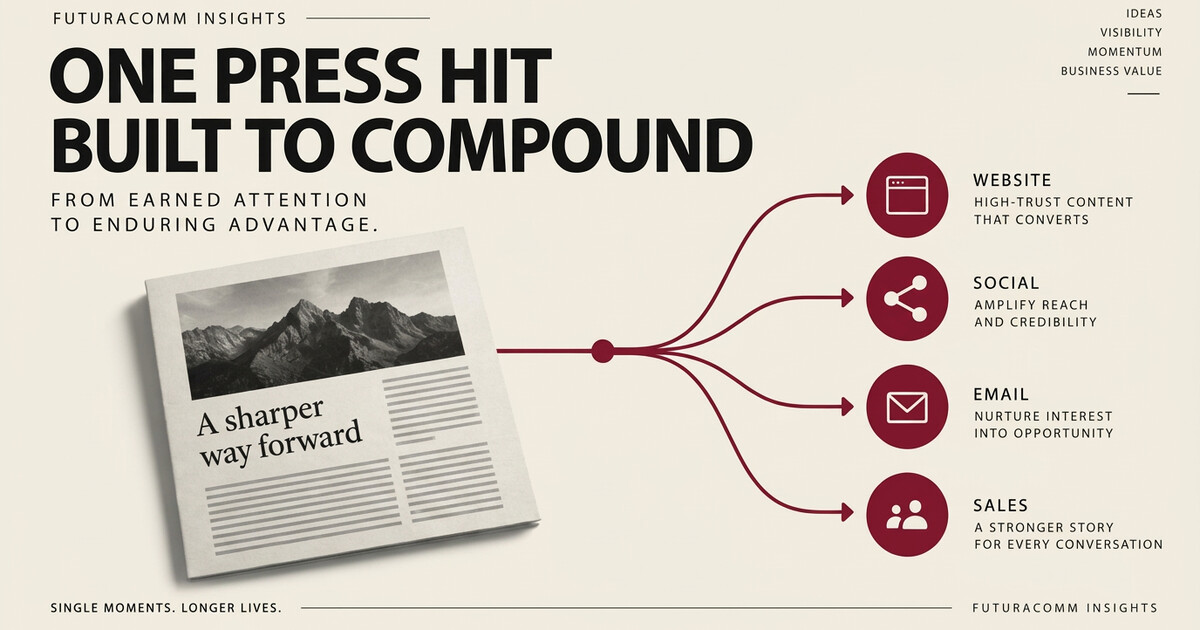
Getting the article, interview or television segment can feel like the finish line.
It is not.
The moment coverage goes live is the point at which a company either converts a temporary burst of attention into a durable business asset—or lets the value decay into a logo buried on a press page.
The difference is not how loudly the company celebrates. It is whether the coverage becomes part of a larger system: a credible story, an owned destination, proof at the moment of decision, useful sales material, original follow-on content, measurable traffic and a foundation for the next legitimate story.
That is the work after the placement.
First, identify what you actually earned
Not every appearance in a publication carries the same meaning.
Earned editorial coverage is independently selected and produced by an outlet. Sponsored articles, native advertising, contributed content, paid placements, affiliate coverage and brand partnerships can all be useful, but they are different assets and should be described accurately.
That distinction matters because the value of media coverage comes partly from what a reasonable reader believes it represents. The Federal Trade Commission’s guidance says advertising should not be formatted in a way that causes consumers to mistake it for independent content, and disclosures needed to avoid deception should be clear and prominent.
Before promoting a story, record:
- The outlet and live URL
- The publication or air date
- The author, host or program
- Whether the piece is earned, sponsored, contributed or paid
- The exact headline and relevant language
- The claims the piece actually makes
- The link, quote, image and logo permissions available
- Any correction or update that may be required
The goal is not to diminish sponsored content. It is to preserve trust by labeling every asset honestly.
The seven-part post-coverage system
1. Preserve the placement without pretending you own it
News sites redesign pages. Headlines change. Programs move behind subscriptions. Social posts disappear. A company needs an internal record of the placement even when the publisher remains the owner of the work.
Save the URL, publication details, approved screenshots, transcripts you are entitled to retain, and internal notes about the story. Record the facts, quotes and themes that are useful to the business.
Then respect the boundary between referencing coverage and republishing someone else’s work.
The U.S. Copyright Office explains that facts themselves are not protected by copyright, while original works of authorship generally are. That is why the safest public pattern is usually to write an original summary, use only a brief accurate quotation when justified, attribute it, and link people to the original story. Reproducing an entire article, photograph, television segment or publisher-designed page calls for a separate rights analysis or permission.
The same care applies to media logos. A publication mentioning a company does not automatically mean every use of its marks is approved. Check the outlet’s brand rules and the specific use before building “as seen in” graphics, ads or packaging.
2. Build an owned destination for the attention
The publisher’s article belongs on the publisher’s site. The business still needs an owned page that explains why the coverage matters.
Depending on the story, that destination may be:
- A press or media page
- A case study
- A founder profile
- A launch page
- A project page
- A newsroom entry
- A service page with a relevant proof module
A useful owned page does more than display a logo. It gives the visitor context:
- What happened?
- Why was it relevant?
- What part of the company’s work did the coverage validate or examine?
- Where can the reader see the original?
- What is the logical next step?
This is also where web and public relations stop being separate disciplines. If the coverage creates interest but the destination is thin, confusing or disconnected from the story, the company has earned attention without preparing a place for it to land.
FuturaComm’s Web Studio builds that owned layer around discovery, trust and action. For website projects, the approved offer is exact:
There is no upfront payment. Nothing is due until you love the completed website and are ready to launch.
3. Put the proof where decisions are made
A press page is useful for people already looking for press. Most buyers are not.
Coverage should appear selectively at the points where third-party context can answer a real question or reduce uncertainty:
- The homepage, when the placement supports the company’s central positioning
- A service page, when the story validates expertise in that service
- A founder or executive page, when the coverage is about leadership
- A proposal, when it is directly relevant to the prospect
- A pitch deck or investor deck, when it substantiates the narrative being presented
- A sales follow-up, when the piece answers the buyer’s concern
- A recruiting page, when it reveals culture, mission or category momentum
Relevance matters more than logo count.
Ten publication marks without context can become visual wallpaper. One carefully chosen story, positioned next to the claim it supports, can do far more work.
Use the coverage to answer “Why should I believe this?”—not merely “Where have we appeared?”
4. Create original content from the story—not copies of the story
One article can create weeks of useful material without turning every platform into the same repost.
Start by separating the components of the story:
- The news event
- The founder’s point of view
- The expert explanation
- The behind-the-scenes process
- The question the journalist asked that customers also ask
- The misconception the story corrected
- The next development the article could not yet cover
Those components can become:
- A founder LinkedIn post about the decision behind the news
- A carousel that explains the underlying process
- A short video answering one question from the interview
- An email that sends the right audience to the original coverage
- A sales note that pairs the story with a relevant next step
- A website FAQ based on a genuine buyer question
- An internal talking-points document so the team tells the same story accurately
The standard is not “How many posts can we squeeze out of this?” It is “What additional value can we add for each audience?”
That distinction also supports search quality. Google’s people-first content guidance asks whether a page adds original information, reporting or analysis and whether it provides substantial value beyond simply copying or rewriting other sources.
5. Equip the people closest to revenue
Coverage often stays inside the marketing team even when its best use is in a sales, partnership or recruiting conversation.
Create a short internal activation brief containing:
- The one-sentence significance of the story
- The audiences for whom it is relevant
- The claims the story supports
- The claims it does not support
- An approved two-sentence description
- The correct link
- Approved graphics or screenshots
- Suggested use cases
- Any disclosure, rights or expiration considerations
Then give the asset to the people who speak with prospects, partners, sponsors, talent, investors and media.
The brief prevents two opposite failures: nobody uses the coverage, or everyone improvises a larger claim than the article supports.
A public example: Anthony “Rumble” Johnson
In 2021, Forbes covered Anthony “Rumble” Johnson’s NFT launch. The article did not exist in isolation: it also described the Mark Cuban outreach, the Lazy.com opportunity and a wider television project. The placement carried several connected narratives at once—athlete reinvention, a new commercial move, a media property and a business relationship that gave the story news value.
The lesson is not that every press hit should produce a television project or a deal. It is that the most valuable coverage usually sits inside a larger strategic arc. The article is one public proof point within that arc, not the entire result.
Readers can review the original Forbes coverage.
6. Measure the path, not an invented publicity value
Media impact is rarely captured by one number.
Avoid treating advertising-value equivalency or raw potential audience as proof of business return. A large theoretical readership does not tell you who saw the story, believed it, visited the company or took action.
Build a measurement record across four levels instead.
Coverage quality
- Was the outlet relevant to the target audience?
- Did the story contain the intended message?
- Was the company or leader represented accurately?
- Did the piece include a useful link or next step?
- Was the coverage earned, sponsored or contributed?
Attention
- Referral sessions from the article
- Engagement on the company’s owned follow-on content
- Video views or interview completion where data is available
- Branded-search movement, interpreted carefully
- New external links visible through Search Console
Google Search Console’s Links report can help confirm which sites point to the company and which pages receive those links. It is not a complete PR-attribution system, but it provides a useful record of link evidence.
Action
- Consultation or contact-page visits
- Qualified inquiries that reference the story
- Email signups
- Downloads
- Speaking, partnership or interview requests
- Opportunities in which the coverage appears in the documented path
Business outcome
- Qualified pipeline influenced
- Partnerships or sponsorships advanced
- Recruiting conversations improved
- Sales cycles in which the proof helped resolve a concern
- Follow-on coverage earned
Use tracked links on the channels the company controls. Google Analytics supports custom campaign parameters and recommends consistent, case-sensitive naming. That means a LinkedIn post, email and paid amplification link can each be labeled cleanly while the canonical article URL remains stable.
Do not claim that coverage “caused” a result unless the evidence supports causation. In many cases, the honest conclusion is that it influenced or assisted an outcome.
7. Use the first story to build the next legitimate story
The weakest follow-up is often a mass email telling every journalist that another journalist wrote about the company.
The better question is: what became newly true?
Coverage may create a next story when it leads to:
- New data
- A documented market response
- A meaningful partnership
- A product or program launch
- A visible milestone
- A strong counterpoint or expert perspective
- Access to a new interview subject
- A development that advances the original narrative
Keep the relationships around the first story professional. Thank the reporter without asking for favors. Provide corrections promptly and narrowly when necessary. Do not add a journalist to marketing lists without consent. Do not treat one response as permanent access.
The goal is to become a reliable source with new information—not a company that repeatedly points back to its last headline.
A practical 30-day activation plan
In the first 24 hours
- Verify the article, spelling, links and material facts.
- Record whether it is earned, sponsored, contributed or paid.
- Save the internal evidence record.
- Thank the journalist, producer or host appropriately.
- Correct only genuine factual errors.
- Publish one accurate company post linking to the original.
In days 2–7
- Add the coverage to the most relevant owned page.
- Build an internal activation brief.
- Give sales, partnerships and leadership approved language.
- Publish one founder perspective that adds something new.
- Create one educational piece from a question raised by the story.
- Verify logo, image, excerpt and clip permissions before creative production.
In days 8–14
- Place the proof into the relevant proposal, deck or service path.
- Review referral traffic and qualified responses.
- Identify questions and misconceptions generated by the coverage.
- Develop a second original asset that addresses one of them.
- Map any new story development rather than repitching the same announcement.
In days 15–30
- Review coverage quality, attention, action and business outcomes.
- Document influenced opportunities without overstating attribution.
- Update the owned page with any legitimate new development.
- Decide whether paid amplification is justified and, if used, disclose the commercial presentation accurately.
- Build the next pitch only when there is a new fact, perspective or consequence.
What not to do after press coverage
- Do not call sponsored content earned media.
- Do not paste the full article onto your site without a rights basis.
- Do not assume the outlet’s logo, photography or video is free to use.
- Do not turn one quote into a broader endorsement.
- Do not claim reach, revenue or ROI you cannot substantiate.
- Do not send visitors to a homepage that has no connection to the story.
- Do not make every social post a celebration of the company.
- Do not badger the journalist for another story.
- Do not let the coverage disappear inside a press archive nobody sees.
The placement is proof. The system creates the value.
Good coverage gives a business something advertising cannot manufacture on its own: an independent public record that another party considered the story worth examining.
But the record does not distribute, explain, measure or compound itself.
The companies that get the most from media coverage treat it as one layer in a connected authority system. They preserve it accurately, respect the rights around it, place it where decisions happen, add original insight, equip their teams, measure the downstream path and use new developments to earn the next story.
That is how one press hit becomes a business asset.
FuturaComm builds strategic public-relations programs around narrative, earned attention and the infrastructure that lets attention compound. Explore our media capabilities or start a conversation.
Frequently asked questions
What should a business do immediately after getting press coverage?
Verify the story’s facts and links, record whether the placement is earned or paid, preserve an internal evidence record, thank the journalist or producer, and publish one accurate link to the original. Then build an owned destination and activation plan rather than flooding every channel with the same announcement.
Can I repost a news article on my company website?
Linking to and accurately summarizing a story is different from reproducing the publisher’s article, photography or video. The original expression is generally protected by copyright even when the underlying facts are not. Obtain permission or legal guidance before republishing protected material.
Can I use a publication’s logo in an “as seen in” section?
Do not assume so. Confirm that the appearance is accurate, review the outlet’s brand or trademark guidelines, and verify that the specific use is permitted. Never format a paid placement in a way that suggests independent editorial coverage.
How can media coverage generate leads?
Coverage becomes more commercially useful when it is placed near a relevant buyer decision, linked to a clear owned destination, used by sales and partnership teams, and supported by a logical next action. Track referral traffic, qualified inquiries and influenced opportunities without claiming causation that the evidence cannot establish.
How do you measure the value of PR coverage?
Measure coverage quality, attention, action and business outcomes separately. Useful evidence can include message accuracy, outlet relevance, referral traffic, external links, qualified inquiries, partnership requests, influenced pipeline and follow-on coverage. Avoid reducing the result to an invented advertising-value number.
Should a company pay to promote earned media coverage?
Sometimes. Paid amplification can put a credible story in front of a relevant audience, but the promotion itself is advertising. The presentation and disclosures should make the commercial nature clear, and rights to use headlines, logos, images or clips should be verified before launch.